

- AI recommendation systems (ChatGPT, Perplexity, Google AI Overviews) synthesize app recommendations from store listings, websites, and third-party sources – optimize all three with consistent messaging to drive traffic to the app
- App store listings are the primary source AI systems cite; structure them with direct answers, semantic clarity, and extractable sections
- 38% of websites cited in AI Overviews rank in Google’s top 10 – ranking position is a requirement for AI discoverability. Content optimization is a must
- GEO (Generative Engine Optimization) is no longer optional; apps must optimize for both traditional search AND AI systems simultaneously
- Measure GEO success through AI referral traffic, branded keyword volume, and search→install conversion rates, not just organic sessions
- Implement tactical practices: schema markup, question-based content, smart banners, About Us optimization, and PWA as distribution alternative
How Are AI Systems Discovering Apps Now?
When a user asks ChatGPT “What’s the best budgeting app for freelancers?” the AI system doesn’t retrieve a single pre-written answer. Instead, it performs live web retrieval across your app store listing, website pages, Reddit discussions, and reviews, then synthesizes a recommendation based on what it finds.
This means an app that’s applying traditional SEO for apps alone will lose to an app optimized for AI extraction. The apps winning in 2026 understand a new concept called GEO (Generative Engine Optimization), which is the kind of optimization that is getting them cited by ChatGPT and other LLMs.
Core GEO Principles: What AI Systems Actually Look For?
1. Ranking Position Matters: Top-10 Ranking Increases AI Citation Probability
According to Ahrefs research on AI Overviews, 38% of websites cited in AI Overview responses rank in Google’s top 10 search results. This changes everything about GEO strategy. This means SEO is definitely not dead, it has revived in the era of GEO. And why is that?
- Your ranking position directly affects whether AI systems find and cite you. Top-10 ranking isn’t just about organic traffic, it’s a prerequisite for AI discoverability.
- Outside the top 10, your citation chances drop sharply. AI systems prioritize high-ranking, authoritative sources.
- For GEO, traditional SEO is the baseline. You must rank first, then optimize for extraction.
The secondary insight: Within top-10 ranking, structure matters. Direct answers, question-based formatting, and extractable FAQ sections make your content more likely to be selected for citation over competitors ranking nearby. AI platforms love comparison tables and videos – anything in that direction could boost your visibility.
2. Semantic Triples – Structure for Extraction
AI systems process information as semantic triples: subject-predicate-object. When you write this way, AI can extract and reuse your content directly.
Bad: “Our app is really useful for tracking things.”
Good: “FreelancePay automatically categorizes business expenses by tax deductibility.”
The good version is extractable. The bad version is vague.
3. Complete, Standalone Answers
Every section should work independently. A user (or AI system) reading just one paragraph should understand the answer without reading the surrounding text.
Bad FAQ:
- Q: How do I use it?
- A: Download the app and start tracking.
Good FAQ:
- Q: Can I share my financial data with my accountant?
- A: Yes. FreelancePay lets you download a tax-ready PDF or grant your accountant read-only access directly in the app. Your accountant can review invoices, expenses, and profit calculations in real time.
4. Consistent Terminology
If your app store says “freelancers” but your website says “self-employed professionals,” and Reddit mentions “independent contractors,” AI treats them as different products. Pick one term and use it everywhere.
ASO vs SEO vs GEO: How They Work Together?
These three disciplines are distinct but complementary. GEO is the emerging layer that ties them together.
| Factor | SEO | ASO | GEO |
| Objective | Rank website in Google Search for app-related keywords | Rank app in App Store / Google Play search | Optimize for AI systems (ChatGPT, Perplexity, AI Overviews) |
| Keywords | Long-tail, question-based (“best fitness app for beginners”) | Short, feature-focused (“fitness app”, “workout tracker”) | Problem-solution phrases (“how to track workouts”) |
| Content Format | Blog posts, landing pages, website content | App metadata (title, description, screenshots) | Direct answers, FAQ sections, semantic structure, schema and brand authority |
| Authority Signals | Backlinks, domain authority, content quality | Ratings, reviews, installs, engagement | E-E-A-T signals, cited by authoritative sources |
| Outcome | Website traffic → App store page → Download | App store search → Direct app download | AI recommendation → Download intent |
The key insight: The best app marketing strategy uses all three. ASO brings downloads from app stores. SEO brings traffic from search engines. GEO ensures your app gets recommended by AI systems. Together, they create a unified discovery strategy.
Case Study: Gaming App – 382%+ Organic Growth in 3 Months
One of our gaming app clients came to us with a critical problem: their website was not optimized for GEO, had very few blog articles, and lacked clear brand identity. More importantly, they had no app download buttons on the mobile version – users researching the app couldn’t install directly from mobile search or AI recommendations in an intuitive way.
The Problem
- Website not optimized for GEO – no schema markup, unstructured content, missing extractable FAQ, comparison tables and videos
- Unclear brand identity on homepage and how-it-works page
- No trust signals (team, credentials, social proof)
- Missing app download buttons on mobile
- No integration between ASO and website strategy
The Strategy
- Implemented comprehensive content strategy including AI-related topics to establish authority
- Added schema markup, structured FAQ sections, and question-based content
- Added app download buttons prominently on mobile version
- Built coherent brand identity with E-E-A-T signals, including star rating and testimonials
- Aligned website messaging with ASO metadata for consistency
The Results (3 Months)
- Organic traffic increased by more than 100%, improving brand and generic search terms altogether
- ChatGPT and AI Overview referral traffic consistently increasing
- All-time record of app downloads directly from website
- Attributed to delivering unique, high-authority content with coherent brand identity and GEO-optimized best practices
This case demonstrates that GEO isn’t a separate channel, it’s an integration of content strategy, brand identity, technical optimization, and ASO alignment. The results speak for themselves.
GEO Best Practices – How to Optimize the Website to Increase Downloads?
GEO principles guide your strategy. Implement them across your website, app store presence, and marketing channels.
QR Codes on Desktop Version
Users researching your app on desktop need a frictionless path to download on mobile. Place a scannable QR code prominently on your website – homepage header, product page, blog sidebars.
A user on desktop who wants to try your app scans once and lands directly in the App Store or Play Store. Trackable via UTM parameters, so you can measure conversion.

Implement Schema Markup for Apps
Add App schema (JSON-LD) to your website pages and app store listings. Per Google Search Central documentation, this signals to search engines and AI systems that your content describes a software application.
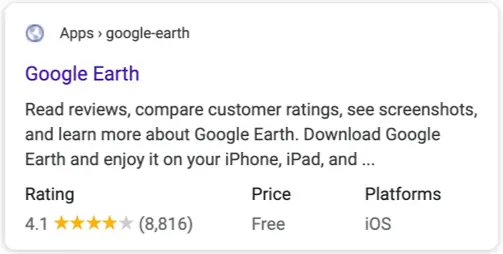
Schema includes: app name, description, rating, download links, platform support, price. Google and AI systems use this structured data to understand and cite your app more accurately.
Smart Banners on Mobile
When users visit your website on mobile, display a native banner at the top or bottom: “Open in App” or “Download.” This banner automatically shows the right CTA for their platform and whether they have the app installed.
Smart banners reduce friction on mobile. Instead of explaining how to find your app in the store, you give them one-tap access. Higher install rates, lower bounce rates.
Here you can find an example of how to use Smart Banners with AppsFlyer.
Optimize Your About Us Page
Your About Us page is critical for both traditional SEO and GEO. It signals E-E-A-T (Expertise, Experience, Authoritativeness, Trust) to search engines and AI systems.
Include: Who you are, why you built this app, what problems it solves, your team’s credentials, social proof (testimonials, awards, media mentions). Make it clear that a real team stands behind this app, not just code.
This builds trust signals that AI systems recognize. An app with a transparent, credible team is recommended with more confidence.
Explore Progressive Web Apps (PWA) as a Distribution Alternative
A PWA is a website that behaves like an app: it loads fast, works offline, installs on home screens, and sends push notifications. No app store required.
Why relevant for app discovery: Not every user will download your native app. 70% of users now prefer PWAs over native apps because they bypass installation friction. Some users may try the PWA and convert to the native app later.
For 2026, PWAs are mainstream. Consider whether your app’s core features work well as a PWA. If so, build one and promote it as an alternative discovery channel alongside your native apps.
Asset #1: Optimize Your App Store Listings (iOS & Google Play)
App store search is the primary discovery channel, and your listing is the #1 source AI systems cite when recommending apps. This is where SEO for apps converges with app store optimization (ASO) – your store listing must optimize for both traditional search AND AI extraction simultaneously.
iOS: The Long Description (GEO-First Approach)
The iOS long description is NOT indexed for keyword ranking in the store, so optimize it 100% for AI extractability and direct answers, not keyword density. Recently, Apple has announced that the iOS long description is now indexed in Google web. This is another great opportunity for optimizing for AI.
Structure with question-based sections:
Who is this for?
Name the audience specifically. “Self-employed professionals – freelancers, consultants, contractors – who need to track invoices and understand their tax obligations without hiring an accountant.”
What’s the core problem?
State the pain point clearly. “Freelance income is unpredictable. Expenses come from different vendors. Most budgeting apps are built for salaried employees with steady paychecks. By the time freelancers realize they owe taxes, it’s too late to plan.”
How does the app solve it?
Explain the benefit, not the feature. “Log an invoice when you send it. Automatically categorizes expenses as tax-deductible or non-deductible. At the end of the quarter, download a tax report ready for your accountant or use to estimate quarterly payments.”
What’s the cost?
Be transparent. “Free for up to 100 transactions/month. Premium ($9.99/month) for unlimited tracking, team collaboration, and direct accountant access.”
Why trust it?
Add social proof. “4.8-star rating with 12,000 reviews. Used by over 50,000 freelancers and trusted by accountants.”
This structure is extractable. When ChatGPT answers “What app helps freelancers with taxes?” it pulls the “How does the app solve it?” section. That’s the win.
iOS: Custom Product Pages (CPPs) – Bridge Website to App Conversion
The long description reaches AI systems. Custom Product Pages (CPPs) convert website visitors into app installs. Create one CPP for each major audience segment, then deeplink to it from your website pages.
How the funnel works:
- Website page /app/freelance-budgeting/ → Deeplink to CPP #1 (Freelancers)
- Website page /app/couples-shared-expenses/ → Deeplink to CPP #2 (Couples)
- Website page /app/small-business-accounting/ → Deeplink to CPP #3 (Small Teams)
Each CPP has its own:
- Custom screenshots & video (audience-specific use cases)
- Promotional text
Why it matters for GEO and conversion:
When a user researches your app on your website, sees the value proposition, and taps “Download,” the deeplink lands them in the exact CPP built for their use case – not a generic store listing. This increases conversion AND signals to AI systems that your app deeply understands specific audience needs (E-E-A-T signal).
Deeplinks are trackable. You measure CPP performance individually, identify which audiences convert best, and refine accordingly. This data informs both your website strategy and your App Store optimization roadmap.
CPP best practices:
- Create 2–4 CPPs maximum (one per major audience segment)
- Match CPP messaging exactly to the website page it links from
- Use screenshots showing the audience solving their specific problem, not generic app features
- Focus on the first 3 screenshots
- Align the website creatives with the CPPs, also matching the hero image, as noted recently in Apple’s WWDC2026
Google Play: Hybrid Approach (App SEO + GEO)
Google Play indexes the long description for search ranking, so you optimize for both keyword ranking AND AI extractability simultaneously.
Use the same question-based structure as iOS, but weave keywords naturally:
“Who uses FreelancePay? Any freelancer or independent contractor using budgeting apps for self-employed professionals needs to track invoices and manage business expenses without an accountant.”
Notice how “budgeting apps for self-employed professionals” and “apps for freelancers” appear naturally within the extractable structure. Google indexes these for keyword ranking. AI systems extract the answers.
Google Play Custom Store Listings (CSL): Set up 2–3 CSLs for your major use cases (Freelancers, Teams, Couples). Each CSL has its own description with the same question-based structure, targeted to that specific audience.
Optimize for Ask Play
Google Play now features Ask Play, an AI-powered Q&A feature that answers user questions directly within the Play Store. The same question-based structure you’re using for long descriptions and CSLs is exactly what Ask Play needs to surface your app. Users asking “What’s the best budgeting app for freelancers?” will see answers pulled directly from your optimized metadata. This is yet another reason to prioritize semantic clarity and complete, standalone answers across all your store listing copy.
Asset #2: Build Question-Focused Website Pages
After finding your app in the store, users research on your website. AI systems crawl your website alongside your store listing. If messaging is inconsistent, AI confidence drops.
Create one dedicated website page for each major use case. This mirrors the conversion rate optimization (CRO) principle: one audience, one page, one clear intent.
Website Page Structure: Question-Based, Answer-Driven
URL: /app/freelance-budgeting/
Hero Section (Answer First):
“Is there a budgeting app built for freelancers? Yes. FreelancePay is built specifically for self-employed professionals. Unlike generic budgeting apps, it’s designed for variable income, automatic tax categorization, and accountant integration.”
Answer the main question immediately. AI systems prioritize top-ranked sites, and once your site ranks top 10, structure like this ensures selection for citation.
How to Measure GEO Success
GEO success is measured differently than traditional SEO or ASO. Here’s how to track what actually matters:
Direct Metrics (AI Impact)
- AI traffic in GA4 – track sessions and users coming through AI platforms like ChatGPT or Perplexity
- Generative AI performance reports in Google Search Console – track visibility through impressions or pages within generative AI features on Search. For example, how often URLs from your site appeared in AI features in Search and Discover. This feature was first announced by Google in June, 2026.
- AI referral traffic in App Store Connect or Google Play Console – track downloads directly attributed to ChatGPT, AI Overviews, or Perplexity
- AI visibility score via third-party tools – monitor whether your app is mentioned in AI-generated answers for target keywords, like SEMrush or SimilarWeb
Indirect Metrics (Search Intent → Install)
- Branded keyword search volume in Google Search Console – increased searches for your app name indicate growing awareness
- Overall organic search traffic to your website – users researching in AI systems, then visiting your site for validation
- CVR (conversion rate) from search to install – measure how many search visitors become app downloaders
The key is tracking the full funnel: AI recommendation → search interest → website visit → app install. This proves GEO is driving real business impact, not just vanity metrics.
Common SEO-for-Apps Mistakes
Based on years of working with app teams, here are the mistakes that cost downloads:
1. No download button on mobile website
Users find your app via search or AI recommendation, land on mobile, and can’t find how to download. They bounce. Fix: Add a sticky mobile download button or QR code prominently visible in the hero section.
2. Inconsistent messaging between app store and website
App says “fitness tracker for runners” but website says “workout app for athletes.” AI treats them as different products. Fix: Use identical terminology and core benefits across all assets.
3. No schema markup
Your content exists, but search engines and AI systems don’t understand it’s about an app. Fix: Add MobileApplication or SoftwareApplication schema to every relevant page.
4. Unclear brand identity and E-E-A-T signals
Website doesn’t clearly explain who built the app or why they built it. AI systems deprioritize apps without clear authorship. Fix: Optimize About Us page with team credentials, company history, and social proof.
5. Burying the answer in your content
Hero section is vague. Direct answer appears in paragraph 4. AI systems cite from the first 30% of content. Fix: Position your core benefit and direct answer in the first 100 words of every page.
The Bottom Line
GEO is not a replacement for traditional SEO or ASO. It’s the integration layer that ties them together. Apps that win in 2026 optimize for all three simultaneously: ranking in Google, ranking in app stores, AND showing up in AI recommendations. Learn more about generative engine optimization (GEO) and how it fits into your overall strategy.
Apps that win in 2026 lead with direct answers, use consistent language across all assets, structure content for extraction, implement tactical best practices, and treat third-party validation as essential. The case study proved this: a complete GEO transformation drove 100%+ organic growth in 3 months.
Start with your app store listing. That’s the most-visited, highest-impact asset. Then build website pages that mirror the messaging. Layer on tactical practices. Measure AI impact directly. Each asset amplifies the others.
Ready to transform your app’s discovery strategy? We help app teams optimize for GEO, SEO, and ASO simultaneously. Let’s talk about your specific situation.
Frequently Asked Questions
Website ranking improvements typically take 6–8 weeks. AI system citations often appear within 3–4 weeks if your content is strong. CPP performance changes appear within 2–3 weeks. Set expectations accordingly with stakeholders. The fastest wins come from deeplink optimization and CPP testing.
Same target audience terminology, same core benefit, same primary pain point. Different framing is fine. Website = educational (“Here’s why freelancers struggle with finances”). App store = commercial (“Download to solve this problem”). Both should answer: “Who is this for and what problem does it solve?”
Very. AI systems weight ratings heavily. A 4.8-star app is recommended with more confidence than a 3.9-star app, all else equal. Focus on encouraging happy users to review and addressing negative feedback quickly.
Partially. iOS apps can rank in web search for app-related keywords through your website content. You’ll rank more easily and comprehensively if you’re on both platforms. If you’re iOS-only, double down on your website presence.